
Toyota F33A-FTV 3.3L Engine: Specs, Reliability, and Owner’s Guide
Toyota F33A-FTV 3.3L twin-turbo V6 diesel engine marked a significant shift in the automotive landscape for Toyota’s most enduring off-road platforms. Launched in 2021, the F33A-FTV debuted in the venerable Toyota Land Cruiser 300 and was later adopted by the Lexus LX 500d. This engine is historic for the manufacturer, representing their first-ever production V6 diesel, […]
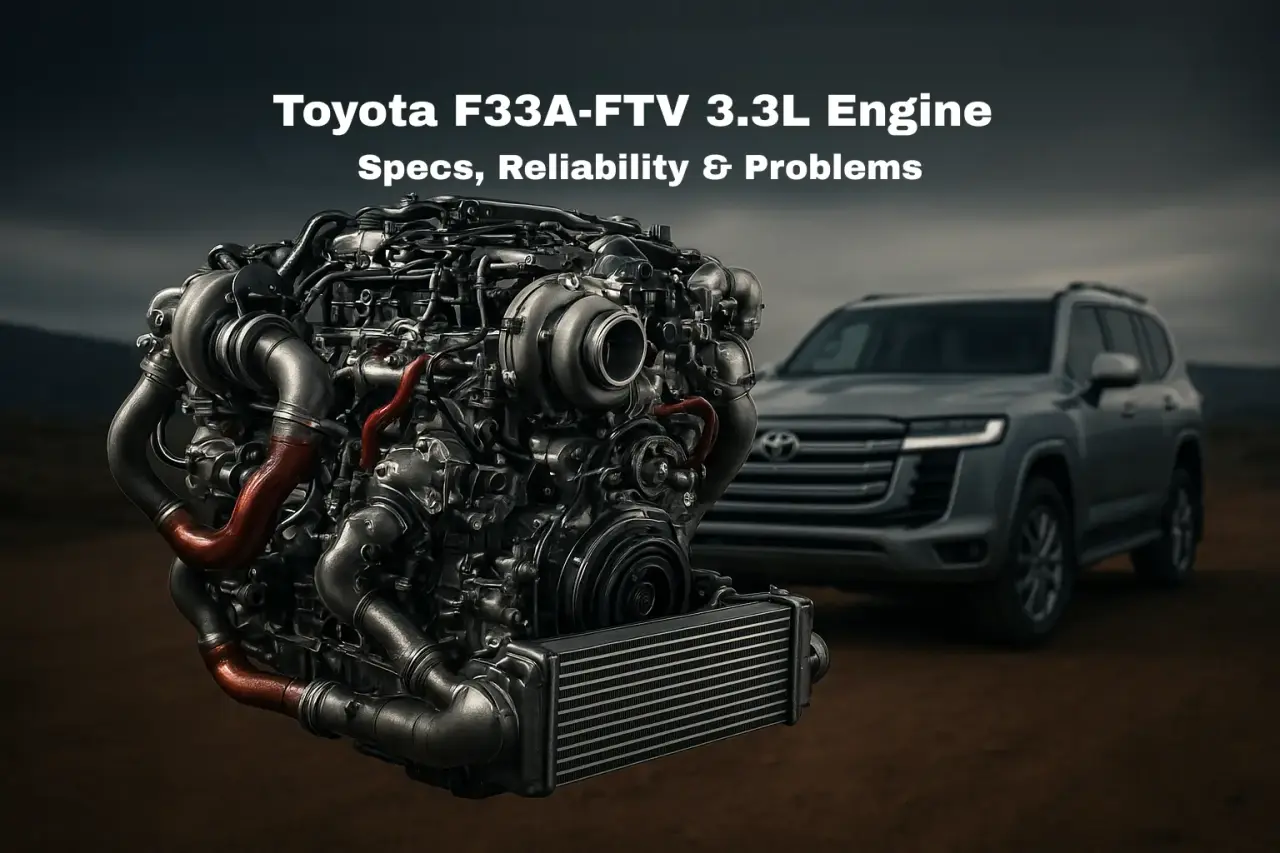
Toyota F33A-FTV 3.3L twin-turbo V6 diesel engine marked a significant shift in the automotive landscape for Toyota’s most enduring off-road platforms. Launched in 2021, the F33A-FTV debuted in the venerable Toyota Land Cruiser 300 and was later adopted by the Lexus LX 500d. This engine is historic for the manufacturer, representing their first-ever production V6 diesel, a powerful successor tasked with replacing the legendary 4.5-liter V8 1VD-FTV.
This comprehensive guide delves into the intricate F33A-FTV specs, examines its robust design, analyzes its performance profile, and addresses the critical questions regarding F33A-FTV reliability and long-term ownership.
The F33A-FTV Engine: A Technical Overview
Toyota engineered the 3.3L F33A-FTV to blend modern efficiency with the uncompromising durability demanded by its flagship SUVs. While displacing less volume than its V8 predecessor, it significantly surpasses the 1VD-FTV in both power and torque, thanks to sophisticated forced induction and fuel delivery systems.
Core Architecture and Design Philosophy
The foundation of the F33A-FTV is a closed-deck, cast iron cylinder block.2 This material choice, favoring cast iron over aluminum, prioritizes exceptional strength, rigidity, and thermal stability hallmarks of Toyota’s philosophy for heavy-duty engines. The closed-deck design further reinforces the cylinder bores, crucial for handling the immense pressures generated by a modern, high-output, turbocharged diesel.
An unusual engineering decision is the 90-degree angle between the cylinder banks, more common in V8 engines than V6 designs, which typically use a 60-degree configuration. This choice is likely a deliberate strategy to leverage tooling and structural elements inherited from the outgoing V8 while ensuring outstanding rigidity and reduced vibration.
Internal Components Engineered for Durability
Within the robust block, the F33A-FTV utilizes high-strength materials designed for maximum longevity:
-
Crankshaft: A durable carbon steel crankshaft handles rotational forces.
-
Connecting Rods: High-strength steel connecting rods are used, featuring a diagonally split design for precise fitment and superior clamping force against the crank journals.
-
Pistons: The engine uses steel pistons, an essential component for surviving the high heat and pressure of modern diesel combustion. These pistons are treated with a Diamond-Like Carbon (DLC) coating to minimize friction and wear, enhancing both efficiency and F33A-FTV lifespan.
-
Timing: The engine employs a dependable chain-driven timing system, consisting of one primary roller chain and two secondary chains, further solidifying its reputation for low-maintenance internal mechanics.
DOHC Heads and Integrated Exhaust Manifolds
Sitting atop the block are aluminum DOHC (Dual Overhead Camshaft) cylinder heads, utilizing a four-valve-per-cylinder layout. The valvetrain features roller rocker arms paired with hydraulic valve lash adjusters. This hydraulic system automatically maintains the correct valve clearance, reducing maintenance requirements and ensuring consistent performance throughout the engine’s life.
A standout design element is the incorporation of integrated and water-cooled exhaust manifolds directly into the cylinder heads. This innovative feature:
-
Reduces the temperature of the exhaust gases before they enter the turbochargers.
-
Improves turbocharger response by maintaining exhaust velocity.
-
Aids thermal management and packaging, which are critical in a compact V6 engine bay.
Performance Metrics and Output
The F33A-FTV’s performance figures demonstrate its capability to move large, heavy vehicles with authority, easily eclipsing the power and torque output of the V8 it replaced.
Specification
Metric Value
Imperial Value
Configuration
V6
V6
Displacement
3,345 cc
204.1 cu in
Bore x Stroke
86.0 mm x 96.0 mm
3.39 in x 3.78 in
Compression Ratio
15.4:1
15.4:1
Power Output
220–227 kW @ 4,200 rpm
295–304 hp @ 4,200 rpm
Torque Output
700 Nm @ 1,600–2,600 rpm
516 lb-ft @ 1,600–2,600 rpm
Engine Weight
265 kg
584 lbs
The High-Torque Power Profile
The most notable feature of the F33A-FTV’s performance is its immense 700 Nm (516 lb-ft) of torque, which is available across a vast portion of the usable rev range (1,600 to 2,600 rpm). This configuration is perfect for the Land Cruiser and LX 500d’s intended use cases, providing effortless towing capacity and superior throttle response for off-road driving.
Furthermore, weighing in at 265 kg (584 lbs), the V6 diesel is significantly lighter and more compact than the outgoing V8, contributing to better weight distribution and improved vehicle dynamics.
Advanced Fuel and Air Management Systems
Achieving high power and strict emission compliance requires advanced, integrated systems for fuel and air management.
Variable Geometry Twin-Turbocharging
The engine’s air supply comes from a pair of Variable Geometry Turbochargers (VGT), allowing for two distinct operational modes:
-
Single-Turbo Mode: At low engine speeds, the system prioritizes exhaust gas flow to one turbocharger. This minimizes turbo lag, delivering rapid boost and torque for excellent initial acceleration.
-
Twin-Turbo Mode: As engine speed increases, the exhaust gas is routed to both turbos, maximizing airflow to achieve peak horsepower and torque, resulting in the impressive power figures shown in the specs.
The intake system also features a liquid-type intercooler. This design provides more consistent and efficient cooling of the compressed intake air compared to air-to-air systems, directly contributing to denser air charge and higher power output.
Denso’s i-ART Common Rail System
The F33A-FTV utilizes a state-of-the-art Common Rail Direct Injection system supplied by Denso, branded as intelligent-Accuracy Refinement Technology (i-ART). The core of this system is the HP5D injection pump, capable of generating injection pressures up to 270 MPa (approximately 39,160 psi).
The i-ART system differentiates itself by incorporating pressure sensors directly into the electromagnetic injectors for each cylinder. This allows the Engine Control Unit (ECU) to monitor and adjust fuel delivery with incredible precision on a per-cylinder, per-cycle basis, leading to:
-
Optimized combustion.
-
Reduced emissions.
-
Enhanced fuel efficiency.
Dual Cooling Circuits
To manage the engine’s considerable thermal load, Toyota implemented two separate cooling circuits:
-
Main Cooling Circuit: Dedicated exclusively to cooling the engine block and heads. It uses a conventional belt-driven water pump, thermostat, and an electro-viscous fan clutch.
-
Secondary Cooling Circuit: This circuit manages the thermal load of ancillary systems, specifically cooling the liquid intercooler, both turbochargers, the AdBlue supply module, and the exhaust fuel injector. This circuit relies on a highly efficient brushless electric pump for circulation.
Emissions Control and The Price of Modern Diesel
To comply with stringent global emission standards, the F33A-FTV is equipped with a complex array of emission control systems.
Comprehensive Emission Technology
Depending on the market, the engine utilizes a combination of the following systems:
-
DPF (Diesel Particulate Filter): A ceramic filter that traps soot particles. Periodically, the system performs a DPF regeneration process by injecting fuel into the exhaust to burn off the trapped soot.
-
SCR (Selective Catalytic Reduction): This system injects a urea-based fluid, commonly known as AdBlue or DEF (Diesel Exhaust Fluid), into the exhaust stream. The fluid converts harmful NOx into harmless nitrogen and water vapor.
-
EGR (Exhaust Gas Recirculation): Cools and recirculates exhaust gas back into the intake to lower combustion temperatures, thus reducing nitrogen oxide (NOx) formation.
-
DOC (Diesel Oxidation Catalyst): Converts hydrocarbons (HC) and carbon monoxide (CO) into water and carbon dioxide.
The Most Common F33A-FTV Problems
As the engine remains relatively new, its internal mechanical reliability appears exceptionally high. However, nearly all F33A-FTV common problems reported by owners revolve around the complexity of the emission systems, a challenge faced by most modern diesel engine manufacturers.
-
DPF Regeneration Issues: Some owners have experienced difficulties with the DPF regeneration process. This can often be traced back to the fuel injectors, which must operate flawlessly to execute the post-combustion injection required for cleaning the filter. Malfunctioning injectors can lead to failed regenerations and costly DPF servicing.
-
SCR System Headaches: The SCR system reliability is a recurring complaint. The required use of AdBlue/DEF adds a running cost (consumption is typically around 2 liters per 1,000 km) and introduces potential failure points, such as sensor malfunctions or crystallization within the fluid system, especially in varying climates or when using low-quality fluid.
-
Oil Consumption: A minor, but noted, issue among some early owners is a measurable degree of motor oil consumption from new. Toyota’s specification for a thin SAE 0W-20 or 5W-30 oil a decision often driven by fuel efficiency targets may contribute to this. While 0W-20 is effective for reducing internal friction and improving fuel economy, some experts suggest a quality 5W-30 or a reduction in the oil change interval may be prudent for long-term use and high-load environments.
Reliability, Longevity, and Maintenance Guide
The core engineering of the F33A-FTV strongly suggests a high potential for F33A-FTV longevity. The use of a cast iron block, steel pistons, and high-strength internal components indicates that Toyota designed this engine to withstand significant abuse and high mileage. Reports from early adopters already hitting over 200,000 miles without major mechanical faults support this assessment.
Essential F33A-FTV Maintenance Practices
Maximizing the engine’s lifespan depends entirely on adhering to a disciplined maintenance routine, particularly given the sensitive nature of the emission controls.
Maintenance Item
Requirement
Rationale
Oil Change Interval
6,000 miles (10,000 km) or 12 months, whichever comes first.
Essential for protecting the DLC-coated pistons and high-pressure turbo system.
Engine Oil
SAE 0W-20 or 5W-30 (check specific vehicle manual).
Use high-quality, fully synthetic diesel-specific oil that meets Toyota’s standards to mitigate potential oil consumption.
Fuel Quality
Always use high-quality, low-sulfur diesel fuel.
Poor fuel quality directly impacts injector performance, which in turn jeopardizes DPF regeneration.
AdBlue/DEF
Monitor fluid level and top up with certified DEF fluid.
Using cheap or non-compliant DEF is the fastest route to SCR system failure and expensive repairs.
DPF Management
Ensure the vehicle regularly runs at highway speeds for 20–30 minutes.
Allows the ECU to complete the DPF regeneration cycle effectively, preventing filter clogging.
F33A-FTV vs. 1VD-FTV: The V8 Legacy vs. The V6 Future
The transition from the 1VD-FTV V8 to the F33A-FTV V6 was a necessity driven by global efficiency and emission mandates.
Feature
4.5L 1VD-FTV V8 Diesel
3.3L F33A-FTV V6 Diesel
Layout
V8
V6
Displacement
4.5L
3.3L
Power (approx)
202 kW (271 hp)
227 kW (304 hp)
Torque (approx)
650 Nm (479 lb-ft)
700 Nm (516 lb-ft)
Weight
Heavier
Significantly Lighter (265 kg)
Technology
Simpler fuel/air/emission controls
i-ART, VGT Twin-Turbo, Advanced Emission Systems
The F33A-FTV represents a superior performance package: it is lighter, produces more torque, and generates higher horsepower than the V8, all while consuming less fuel and meeting the strictest modern emission standards. While the 1VD-FTV enjoyed a reputation for bulletproof simplicity, the F33A-FTV pushes the boundary of performance and efficiency into the next generation of Toyota utility vehicles.
Conclusion: The Verdict on Toyota’s New Diesel V6
The Toyota F33A-FTV 3.3L twin-turbo V6 diesel engine is a masterclass in modern diesel engineering, successfully replacing a beloved V8 with a more powerful, more efficient, and technologically advanced successor.
From its reinforced, closed-deck cast iron block and DLC-coated steel pistons to its intelligent Denso i-ART fuel system and advanced variable geometry turbos, the internal design screams durability and long-term reliability. The engineering choices, such as the 90-degree V6 architecture, demonstrate a commitment to utilizing proven structural components while maximizing performance.
For potential owners, the verdict is clear: the F33A-FTV offers robust, class-leading V6 diesel performance. Its ultimate longevity is contingent upon meticulous maintenance, particularly the fastidious management of its sophisticated emission control systems (DPF and SCR). By prioritizing quality fuel, proper oil, and adhering to strict service intervals, the F33A-FTV is poised to become the next legendary diesel engine in Toyota’s storied history.
Related reading

toyota
Land Cruiser Petrol vs Diesel: Which Engine is Right for You?
Land Cruiser Petrol vs Diesel: Which Engine is Right for You? When choosing between a diesel Land Cruiser (LC) and a petrol Land Cruiser, prospective buyers often weigh factors such as performance, fuel economy, maintenance costs, durability, and resale value. This detailed comparison will help you determine which variant best suits your needs. 1. Understanding […]
toyota
AdBlue Diesel Exhaust Fluid — What It Is and Which Cars Need It
AdBlue (DEF) is the urea-based fluid modern diesel SCR systems use to cut NOx emissions. Learn how it works, which Toyota, Mercedes, BMW, Audi and VW models need it, what happens when you run out, and where to buy AdBlue in Pakistan.
toyota
Toyota AdBlue in Diesel — Prado 1GD, Hiace, Land Cruiser
Toyota AdBlue (DEF) is factory-fitted on Prado 1GD-FTV, Hiace 300 series and Land Cruiser diesels for Euro 6 emissions. Learn how it works, common DTCs (P203C, P204C, P205D), what happens if you run out, and how Fixmycar.pk Islamabad services Toyota SCR systems in Pakistan.

toyota
Toyota Land Cruiser V8 2UZ-FE Remap
Toyota Land Cruiser The Toyota Land Cruiser V8 is a quintessential example of the reliable craftsmanship synonymous with the Toyota brand. Boasting a robust build and unparalleled durability, the Land Cruiser V8 is a testament to Toyota’s commitment to quality and performance. With its legendary reputation for off-road capability and luxurious interior amenities, the Land […]
toyota
Toyota FJ40 Custom Built, For Sale, and Export Service to USA by Fixmycar.pk
The Toyota FJ40 Land Cruiser is a legendary off-road vehicle with a rich heritage that continues to capture the hearts of car enthusiasts worldwide. At Fixmycar.pk, we are proud to offer custom-built Toyota FJ40 for sale and export services to the USA, catering to collectors, off-road adventurers, and vintage car lovers. Our dedication to restoring […]
toyota
Amsoil Engine Oil for Toyota Prius & Aqua Hybrid Vehicles
Popular Hybrid Vehicles While choosing Amsoil engine oil for Toyota Prius, Aqua and Honda Vezel, please note that Amsoil is the best engine oil available in the world. The sheer stability and Thermal degradation is least in both the Signature series and the XL series of Amsoil. Aqua Prius Alpha Toyota Model C (Aqua) Hybrid […]